When Kefilwe* was five years old, nightly arguments started erupting between her parents in her comfortable home in the northwest village of Makalamabedi. Nothing, from the family finances to the care of elderly relatives, was safe from their barbed underhanded comments and unsparing accusations. Embattled and bitter, her parents decided to split up. Her mother remained in their home village while her father moved 70 km away to Maun.
At first, Kefilwe stayed with her father in Maun. She happily enrolled at Mathola Primary School, and the dust from her childhood upheaval began to settle. But two years later, her father found employment in Francistown, a large metropolitan area located six hours from Maun. Her mother opposed Kefilwe’s move, so she took her daughter back into her home in Makalamabedi, where she now stayed with her new husband and her stepchildren.
The moment Kefilwe moved into her old village, she knew things had irreversibly changed from her early childhood life. Her stepfather and his relatives were demanding and abusive, frequently saddling her with innumerable household chores that took her away from her schoolwork and her friends. While her stepsiblings were free to roam and play around the village, the exploited Kefilwe bore the brunt of the compound’s domestic work. Her mother and stepfamily collected the bountiful dividends of her free, consistent labour at the cattle post, at relatives’ compounds, and in their own home.
The coerced labour and the sexual abuse that ensued when she reached adolescence became too much for Kefilwe. She tried numerous times to run away: to her father in Francistown, to her friends in Maun, even to the nearby village of Chanoga, where she knew not a single soul. But each time, one person or another would bring her back to Makalamabedi. Whether speaking to the government social worker or to inquisitive neighbours, her stepfamily used the same excuse: Kefilwe was a naughty girl who needed to be reformed through long stays at the cattle post or virtual incarceration at their home.
For many Batswana, this is a familiar story. Young girls and boys are often vulnerable to the exploitive coercion and control wielded by parents or caregivers. Rather than protect the rights of their children, some caregivers subject them to forced or coerced labor, defilement, and underage marriage. But, unbeknownst to many people in Botswana, these situations are straightforward examples of human trafficking.
The common perception of human trafficking is rather narrow: a family friend promises a job in Johannesburg to a pretty young girl who failed out of school. She eagerly agrees and travels south in an unmarked combi. Upon arrival, she is drugged and dragged to a brothel where she is forced to become a prostitute. Her traffickers control her through physical and sexual violence, isolation, and repeated threats to harm her loved ones back in Botswana. The captors pocket all of her earnings, and she is inextricably trapped as a modern-day slave.
While this phenomenon of cross-border trafficking and sexual exploitation does indeed happen in Botswana, other scenarios are more common: the Zimbabwean man trapped on a farm and subjected to forced labour because his boss destroyed his immigration documents. The boy whose family sends him to a friend’s cattle post to become a herdboy, taking all of the money and denying the child access to school. The young woman working in the bush for a safari company whose physical isolation and meager salary prevent her from refusing her employer’s entreaty that she “entertain” the guests.
After all, human trafficking boils down to three main components: the act, the means, and the purpose. Consider the following diagram from the United Nations Office on Drugs and Crime:
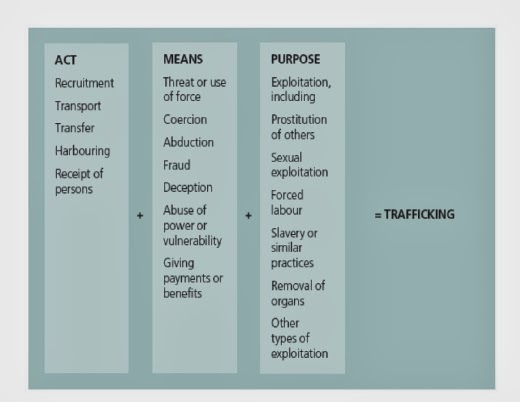
All of the above examples, including that of Kefilwe, constitute as examples of human trafficking.
It’s time that Batswana view them as such. Too much silence surrounds issues like underage marriage and tourism industry sexual exploitation. Too many labour practices are exploitative and in violation of individual freedoms. Too many young children like Kefilwe are denied access to education and supportive care for their individual development that are theirs by human right.
Speaking of Kefilwe, our young survivor of human trafficking has a happy ending. In her late teens, she stole away to Maun and wound up on the doorstep of a single middle-aged woman. After eagerly cleaning the lady’s house from top to bottom, Kefilwe hammered out an agreement with her: she would perform basic household tasks in exchange for food, accommodation, and the requisite school fees. Two years later, Kefilwe not only received her Botswana General Certificate of Secondary Education (BGSCE), but she went on to complete her Bachelor’s Degree at university and is now the director of a Maun-based organization for orphans and vulnerable children.
But most victims of human trafficking are not as lucky as Kefilwe. Action on this issue is paramount: national data collection, national anti-trafficking legislation, community-based awareness campaigns, stronger services and referral systems between the Social and Community Development Office and the police. Bagaetsho, let’s start now.
*Name and identifying details have been changed.
 Daniella Montemarano