Turning Moments into Movements

“Movements are about moments,” said Esta Soler, one the pioneers in America’s fight against gender-based violence, during a TED talk in December 2013.

Indeed, they are. These moments can be famous and extensively publicized, like Martin Luther King Jr.’s “I Have a Dream” speech. They can be quiet moments of individual triumph, like Leymah Gbowee’s transformation from domestic abuse victim to international peace activist. They can be moments of happiness, like Nelson Mandela’s release from prison, or moments of sadness, like Anne Frank’s death at Bergen Belsen.

Movements are built on moments because at the heart of our human rights crusades and peace campaigns are individual human beings. In order for us to transform society, we have to transform each man and woman.

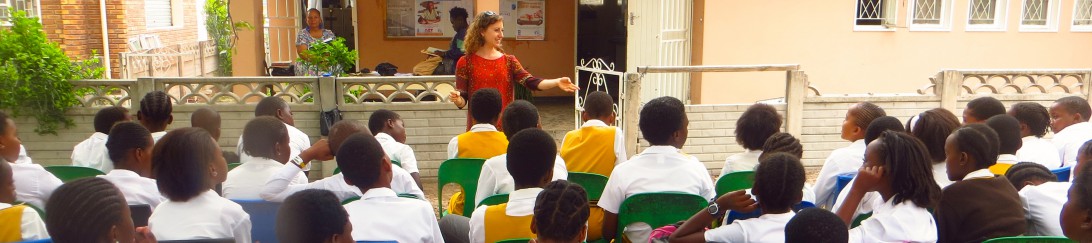
One of my “moments” came last week. I helping facilitate at a training run by the Southern Africa Regional Environmental Program (SAREP) for the local Okavango Artists’ Association’s Adopt-a-School Mural Campaign. The campaign is an initiative to paint twelve HIV and AIDS-related murals in schools across the region and use these murals as tools for community dialogues and interventions.

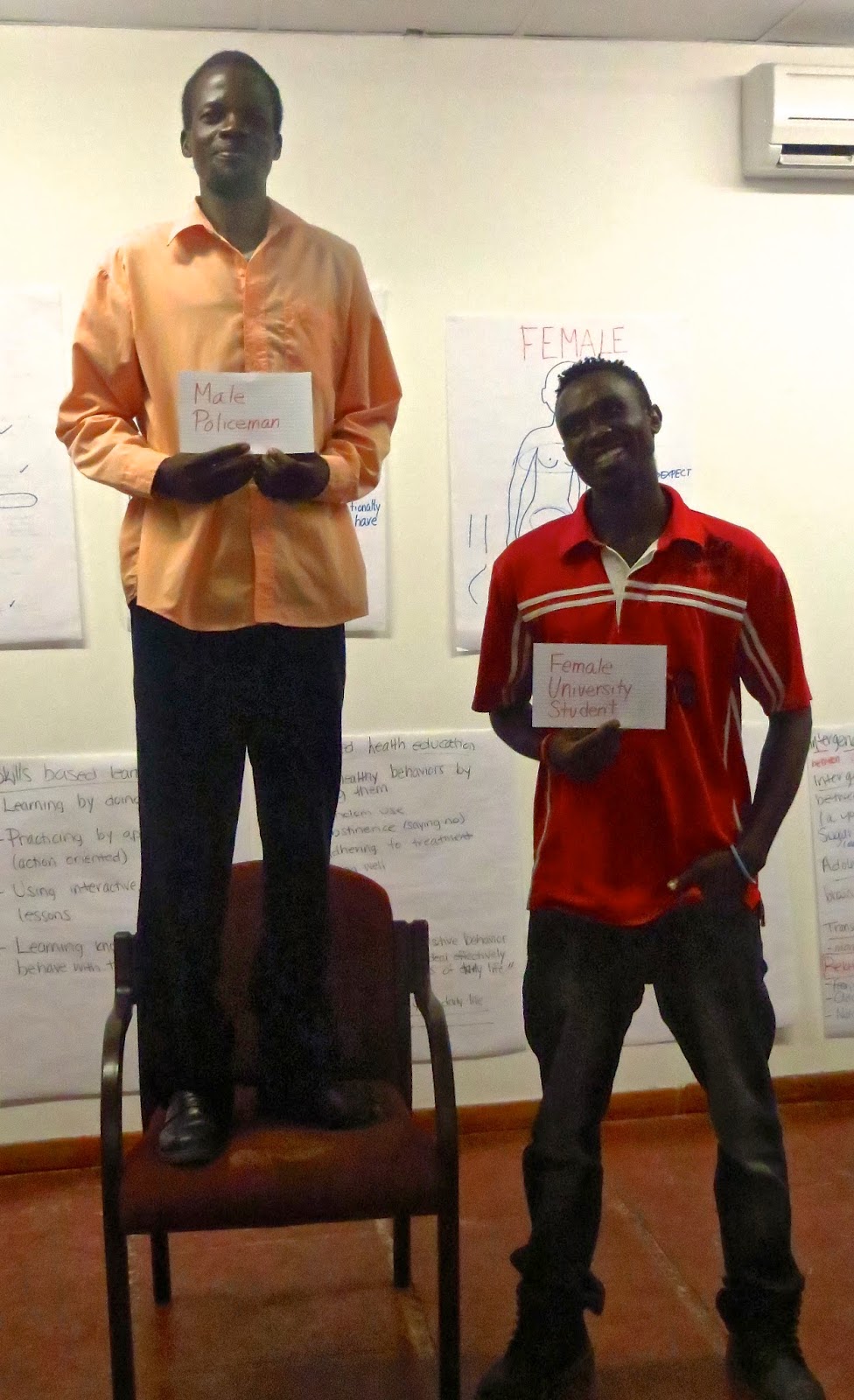
On Day Two of the training, I led a session on gender-based violence. Instead of giving a dry Power Point presentation, I created a dynamic mini-training featuring components such as Drawing the Difference: Gender vs. Sex and The STEP UP Gender Roles and Power Game. These components were immediately effective. As I led the group through the inequalities of traditional gender roles and their power dynamics, several of the participants responded to the messaging with bright eyes and forthcoming anecdotes. “Aha” moments were happening all around me as they connected gender to power to violence to HIV and AIDS.

The STEP UP Gender Roles and Power Game

The next day, I followed up my presentation by screening a STEPS film to the participants, a group almost entirely made up of men. The film tied in nicely with my previous session since it featured Kennedy, a new father challenging traditional Tswana gender roles by being a hands-on dad (e.g. sitting with the mother while she was in labor, changing diapers, feeding the infant).

After the film had finished, the men in the room were in a daze, smiling tenderly down at their papers. Mr. Ntema, one of the artists in the room, was visibly moved to the point where I saw him brush a tear out of his eye.

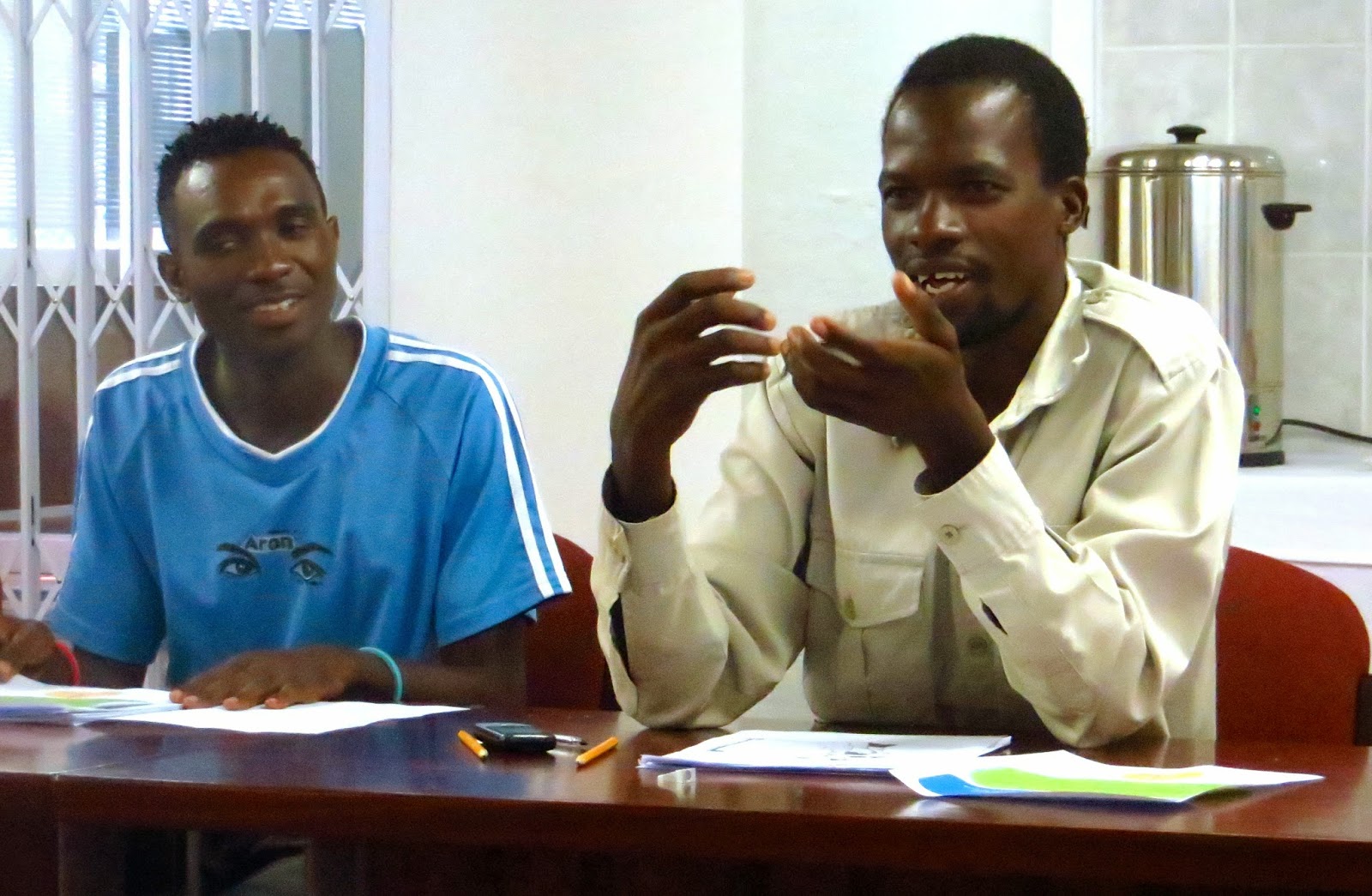
As we started the post-film discussion, I saw just how deep that emotional connection went. Mr. Ntema was the most verbose: he passionately expressed how the film reminded him of the year when he replaced his daughter’s mother as her sole caregiver. He talked with pride and overwhelming love about how much he enjoyed raising her. Another artist, Aaron, responded more quietly, but he also expressed gratitude for the film for showing him that he can be a hands-on father.

(L to R) Aaron and Mr. Mothaki during the post-film discussion

After the artists shared their initial reactions, the discussion cycled back to the material covered the day before. “This is how we change gender roles,” they observed. “This is how we stop gender-based violence.” Right there in that air-conditioned conference room, they connected the training material and Kennedy’s example from the film to their own lives. That was a moment of transformation for each man in the room.

Meanwhile, in her 2013 TED talk, Esta Soler went on to say that, “Men want to be invited, not indicted.” Across the board and around the world, this remains true. If we vilify men in our activism around issues like gender-based violence, we exclude half of the population from forging solutions in our communities. Our brothers, fathers, boyfriends, and sons are our allies. The more moments of transformation we experience together, the more our movement grows.

Why Batswana Should Care About Human Trafficking

When Kefilwe* was five years old, nightly arguments started erupting between her parents in her comfortable home in the northwest village of Makalamabedi. Nothing, from the family finances to the care of elderly relatives, was safe from their barbed underhanded comments and unsparing accusations. Embattled and bitter, her parents decided to split up. Her mother remained in their home village while her father moved 70 km away to Maun.

At first, Kefilwe stayed with her father in Maun. She happily enrolled at Mathola Primary School, and the dust from her childhood upheaval began to settle. But two years later, her father found employment in Francistown, a large metropolitan area located six hours from Maun. Her mother opposed Kefilwe’s move, so she took her daughter back into her home in Makalamabedi, where she now stayed with her new husband and her stepchildren.

The moment Kefilwe moved into her old village, she knew things had irreversibly changed from her early childhood life. Her stepfather and his relatives were demanding and abusive, frequently saddling her with innumerable household chores that took her away from her schoolwork and her friends. While her stepsiblings were free to roam and play around the village, the exploited Kefilwe bore the brunt of the compound’s domestic work. Her mother and stepfamily collected the bountiful dividends of her free, consistent labour at the cattle post, at relatives’ compounds, and in their own home.

The coerced labour and the sexual abuse that ensued when she reached adolescence became too much for Kefilwe. She tried numerous times to run away: to her father in Francistown, to her friends in Maun, even to the nearby village of Chanoga, where she knew not a single soul. But each time, one person or another would bring her back to Makalamabedi. Whether speaking to the government social worker or to inquisitive neighbours, her stepfamily used the same excuse: Kefilwe was a naughty girl who needed to be reformed through long stays at the cattle post or virtual incarceration at their home.

For many Batswana, this is a familiar story. Young girls and boys are often vulnerable to the exploitive coercion and control wielded by parents or caregivers. Rather than protect the rights of their children, some caregivers subject them to forced or coerced labor, defilement, and underage marriage. But, unbeknownst to many people in Botswana, these situations are straightforward examples of human trafficking.

The common perception of human trafficking is rather narrow: a family friend promises a job in Johannesburg to a pretty young girl who failed out of school. She eagerly agrees and travels south in an unmarked combi. Upon arrival, she is drugged and dragged to a brothel where she is forced to become a prostitute. Her traffickers control her through physical and sexual violence, isolation, and repeated threats to harm her loved ones back in Botswana. The captors pocket all of her earnings, and she is inextricably trapped as a modern-day slave.

While this phenomenon of cross-border trafficking and sexual exploitation does indeed happen in Botswana, other scenarios are more common: the Zimbabwean man trapped on a farm and subjected to forced labour because his boss destroyed his immigration documents. The boy whose family sends him to a friend’s cattle post to become a herdboy, taking all of the money and denying the child access to school. The young woman working in the bush for a safari company whose physical isolation and meager salary prevent her from refusing her employer’s entreaty that she “entertain” the guests.

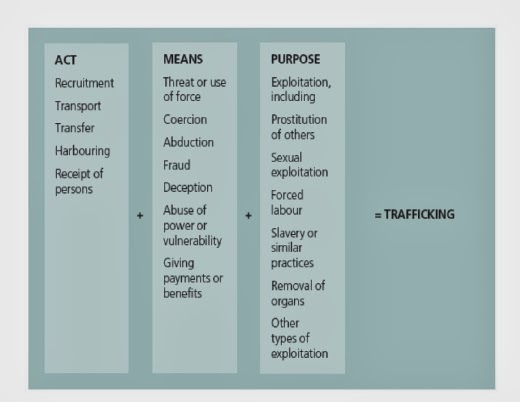
After all, human trafficking boils down to three main components: the act, the means, and the purpose. Consider the following diagram from the United Nations Office on Drugs and Crime:

All of the above examples, including that of Kefilwe, constitute as examples of human trafficking.

It’s time that Batswana view them as such. Too much silence surrounds issues like underage marriage and tourism industry sexual exploitation. Too many labour practices are exploitative and in violation of individual freedoms. Too many young children like Kefilwe are denied access to education and supportive care for their individual development that are theirs by human right.

Speaking of Kefilwe, our young survivor of human trafficking has a happy ending. In her late teens, she stole away to Maun and wound up on the doorstep of a single middle-aged woman. After eagerly cleaning the lady’s house from top to bottom, Kefilwe hammered out an agreement with her: she would perform basic household tasks in exchange for food, accommodation, and the requisite school fees. Two years later, Kefilwe not only received her Botswana General Certificate of Secondary Education (BGSCE), but she went on to complete her Bachelor’s Degree at university and is now the director of a Maun-based organization for orphans and vulnerable children.

But most victims of human trafficking are not as lucky as Kefilwe. Action on this issue is paramount: national data collection, national anti-trafficking legislation, community-based awareness campaigns, stronger services and referral systems between the Social and Community Development Office and the police. Bagaetsho, let’s start now.

*Name and identifying details have been changed.

Why Batswana Youth Failed

Last Wednesday night, Botswana’s breaking news was big. Shocking, even.

Only one-third of Form Three* students who sat for their Junior Certificate Examination (JCE) achieved a passing grade of a ‘C’ or above.

Within 24 hours, Twitter blew up with Batswana expressing their discontent and offering up reasons for this decline in academic achievement. Behold…

@nkwasha This is a national crisis #JCERESULTS the sooner this is addressed the better, no more short cuts..

@Lishulo As citizens of Botswana, we ought to be ashamed of the #JCERESULTS and openly express such shame and disgust

@Nonofo_Milton Factors that contributed to the bad #JCERESULTS

*0.Facebook

*twerking

*Railpark

*Twizza/Chill

*Attitude

@Tshegetembes Social media is no problem but rather the attitude towards social media.please take those cell phones away from them #JCERESULTS

As for myself, I beg to differ with @Nonofo_Milton. Some students may be too distracted with Facebook or twerking to bother reviewing their notes and revisions. But this is a complex issue; not one thing is to blame. There are many reasons for why 65.7% of Form Three students may not not proceed to Senior Secondary School this year, and here are mine:

1.) Barutabana (teachers)- It’s well-known in Botswana that teachers are underpaid and under-appreciated. As a result, they are demoralized and dissatisfied. But can you blame them? They are not classified as “essential” employees of the government, and the transfer system for civil servants repeatedly uproots them from their homes and students. And, up until 2013, they hadn’t seen a government pay scale increase since 1994.

What’s more is that teaching is often seen as a vocation–a position for those who have passion for educating the next generation. But in Botswana, where the government employs roughly 60% of the workforce, teaching is often perceived as another way to earn a paycheck. When the clock strikes 4:30pm, it’s time to pack up and head home because they are just another civil servant. This is reinforced by statements from the Secretary-General of the Botswana Federation of Public Sector Unions (BOFEPUSO) in 2010, who advised teachers in light of the union-government negotiations deadlock to “only to work as per the normal hours of work for government employees…unless advised by the union leadership.” (Gazette 2010, p. 2)

It takes extra energy to invent creative teaching tools and to engage students beyond lectures. With a mindset of an ordinary civil servant and without incentives like adequate overtime pay to encourage them to go above and beyond their job requirements, teachers pass over the little things that make a difference in a child’s education: after-school tutoring, mentorship, extracurricular activities, and positive encouragement. Deficiency in teachers’ efficacy means one thing: bad test results.

2.) Batsadi (parents)- A common social problem in Botswana is the lack of parental/caregiver involvement in many children’s academic lives. As my friend Itseng put it, “We view our children’s school performance as the teacher’s job, not ours.” It’s not as if parents don’t care about their children’s academic performance; parenting culture just doesn’t involve active engagement in the learning process.

Yet, studies repeatedly demonstrate that one of the highest predictors of youth academic success isn’t household income or social status, but rather the level of engagement from parents and caregivers at home. This involves checking homework, reviewing notes, offering feedback on papers, and so on. Even illiterate caregivers or those lacking a high level of education can talk to their children about their school work on a daily basis to show interest and positive support.

Of course, there are certain parenting ills that plague the lives of Batswana children. Emotional and physical abuse, neglect, even defilement: I’ve seen these nightmares derail even the most driven students. As community leaders/activists, friends, relatives, social workers, and teachers, we have a responsibility to the children around us, especially those from vulnerable backgrounds. If you personally know a child victim of abuse, report the case to a social worker or directly to the police. Shower that child with love and compassion. Encourage him or her in their studies and life pursuits. Don’t let them give up on their future.

3.) Tsekaiso ya skolo (the education system)- A colleague once remarked to me, “The Botswana school system isn’t set up to nurture students. It’s there to weed out the smart ones from the dumb ones and to do it quickly.”

While a bit brash, this statement reveals the education system’s problematic approach to students. First, as I’ve stated before, primary and secondary school learning in Botswana is structured around children passing their exams. The vast majority of teachers instruct through lectures that encourage rote memorization instead of critical thinking and active engagement with the material. Then, when students begin preparing for their exams, they repeat phrases over and over to themselves so they can spit them out on the test. Those who don’t have adequate short-term memorization skills fail, and the few who actually do remember their notes word-for-word struggle to explain the concepts in their own unique language.

The ESL (English as a Second Language) instruction in schools is also subpar and obstructs students’ success in their other subjects. Most children attend Setswana-medium primary schools and begin formally learning English in Standard Four. When they enter junior secondary school as Form One students, the language of instruction switches to English. By that time, few students have the vocabulary and a good grasp of basic grammar and syntax to not only perform well in their English classes but also to deeply comprehend material in classes like Agriculture or Social Studies. This results in bad marks straight down their results slip.

In addition to these components, other problems abound in the education system, from large class sizes that paralyze teachers to convoluted grading systems, to subpar housing and toilet facilities for boarding students who reside on campus. Sexual relationships between students and teachers are also a frequent problem as is the absence of teachers due to refresher trainings. It’s amazing to that students can concentrate in these challenging learning environments.

4.) Goromente ya Botswana (the government of Botswana)- Who is responsible for setting education policy? Who is responsible for renovating decrepit building structures and public facilities so that children can enjoy a positive learning environment? Who is responsible for investigating and resolving issues of corruption and illicit student-teacher relationships? Who is responsible for managing teachers–for incentivizing their performance, for improving their working conditions, for firing ineffective instructors?

The government of Botswana. Step up to the plate, guys.

5.) Baithuti (students)- Of course, some of the responsibility for the high failure rate belongs to the students themselves. At the end of the day, these youth hold their future in their own hands. They know the consequences of going through life without their Junior Certificate. They see their peers who failed their exams in years past sitting at home in a daze of malaise and hopelessness. Despite the overwhelming odds against them, these youth should stand up and push back against a system that sets them up to fail.

Right now, you should walk away from this blog post with one number in your head: 12,744**.

12,744 young Batswana will not proceed with their education this year.

12,744 young Batswana will not attend university or college.

12,744 young Batswana will most likely sit at home, unable to find employment.

12,744 young Batswana will not achieve their dreams of a higher education and a better life.

*For my American readers, here is the “educational translation” from the Botswana system to the American system.

School Botswana United States
Primary School Standard One First Grade
Standard Two Second Grade
Standard Three Third Grade
Standard Four Fourth Grade
Standard Five Fifth Grade
Standard Six Sixth Grade
Standard Seven Seventh Grade
Junior Secondary School Form One Eighth Grade
Form Two Ninth Grade
Form Three Tenth Grade
Senior Secondary School Form Four Eleventh Grade
Form Five Twelfth Grade

**The original posting of this blog on January 29, 2013 cited the number of children who will not advance to Form 4 to be 25,206. Later that day, the Daily News released an article stating that 26,200 students who sat for their JC exams will proceed to Senior Secondary. Now, the number of youth who will not advance is 12,744.