Three weeks ago when Pope Francis declared Armenia to be the first genocide of the 20th century, plenty of voices clamored in response. Human rights activists and memorialization experts praised his boldness. Turkey and those with political interest in Armenian denial resisted the damning ‘genocide’ label. And Namibians, other Africans, and those who know their history tried to remind the world that the Pope was wrong.
The historical truth is that the Namibian Genocide, perpetrated by Germany in its South West Africa colony from 1904 to 1908, is the first genocide of the 20th century. During those years, Germany responded to uprisings from the Herero and Nama ethnic groups with a policy of extermination. This policy was carried out with concentration camps, shoot-on-site reprisals, forced marches into deadly inhospitable deserts, and the world’s first killing centers. At the end of Germany’s genocide campaign, 75,000 men, women, and children from the Herero and Nama ethnic groups had been systematically murdered.
The Namibian Genocide belongs to a larger narrative of atrocities perpetrated in modern history. Its horrors certainly sound familiar: women and children forced to perform grueling manual labor on a daily cup of rice; race scientists imported from the German Fatherland to perform fatal “experiments” on genocide victims; and even an extermination order to boot. But somehow, these atrocities escaped the Pope’s attention. Here are three reasons why:
1.) Colonial Amnesia– ‘Colonial amnesia’ is a serious syndrome whereby ethnic subjugation and annihilation are justified or downplayed in the pursuit of empire and ‘civilization.’ Its origins–ethnic paternalism, Christian evangelism, and biological racism–may seem out of place in mainstream Western society. But subtle strains of colonial amnesia are still present today: movies that glorify colonial battles, Columbus Day celebrations, the survival of Leopold II statues in Brussels. Even nativist perspectives in the immigration debate arise partly from ignorance of the effects of colonialism’s socioeconomic crimes.
Recognition of Namibian Genocide suffers from the fact that its atrocities occurred in the thick of the colonial era. During their time as masters of South West Africa, the Germans maintained tight control over the past, spinning stories of brave soldiers defending the Fatherland against African savagery. The extermination of the Herero and Nama peoples was nowhere to be found in their nationalist narrative.
Decades later, in the wake of the Holocaust, Germany and the global community were attempting to reconcile Nazi crimes with its national identity. But were the Holocaust’s race scientists, killing centers, and dreams of Lebensraum connected to the Namibian Genocide? No, because the Allied powers running the Nuremberg Trials couldn’t invalidate the particular racism underlying their own colonial projects. Even Raphael Lemkin, the father of genocide studies, had difficulty connecting the dots between the Namibian Genocide, colonialism, and European racism in Africa and Asia.
Criticism of Germany’s colonial area and frank discussion about the Namibian Genocide remains scarce. During the postwar years, Nazi monuments were dismantled, some of which were replaced by public works glorifying German colonialism. Unlike other countries, Germany didn’t have a postwar anticolonial intelligentsia lambasting the European empires. German recognition reached a turning point in 2004 when Federal Minister Heidemarie Wieczorek-Zeul expressed regret and sorrow over the atrocities at the genocide’s 2004 centennial commemoration. Yet the German government has deemed Zuel’s speech to be private remarks, not an official apology. To this day, motions recognizing the Namibian Genocide are routinely defeated in the Bundestag and most of the country remains under the spell of colonial amnesia.
2.) Minority Rule– During World War I, the Union of South Africa invaded and captured South West Africa in alliance with Great Britain. With expansionist interests close to their hearts, South African leaders internationally condemned German colonialism and exposed the atrocities committed against the Nama and the Herero. When South Africa became the administrators of the Mandate of South West Africa post-Versailles, it scrambled to rebury the genocide to make way for minority rule.
South Africa silenced history most infamously through the burning of the Blue Book, Great Britain’s damning report on the Namibian Genocide. Published in 1918, it featured sworn testimonies, excerpts from translated German documents, and damning photographic evidence of the atrocities committed. Originally an anti-Germany advocacy tool during the Great War, the Blue Book became a liability upon South Africa’s takeover of present-day Namibia. In 1926, British and South African leaders burned all available copies of the Blue Book, thus eliminating the most comprehensive account of the Namibian Genocide.
Beyond the Blue Book, South Africa created a culture of denial surrounding the events of 1904-08. It resuscitated Germany’s virulent racism during its years in control of present-day Namibia by reviving Germany’s segregation and forced labor strategies. These mechanisms especially flourished with the construction of the apartheid state following the Nationalist Party’s 1948 electoral victory. It united its Boer and German populations under a single white settler society, ensuring the survival of white supremacy ideology and the silence over the genocide until Namibian Independence in 1990.
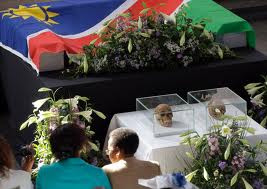
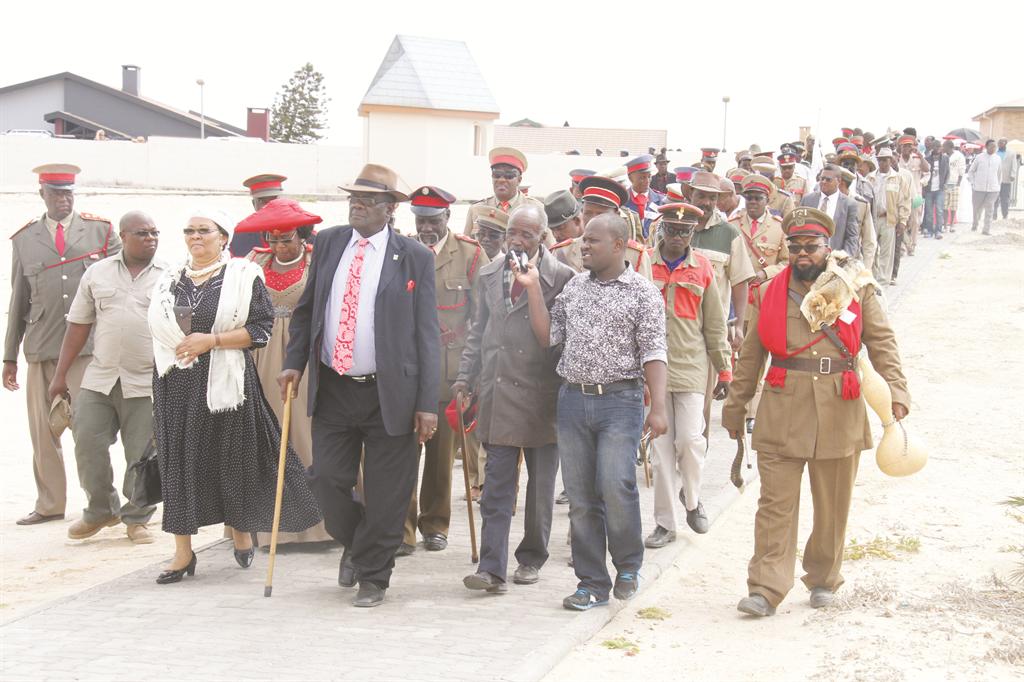
3.) Politics of Remembrance – In spite of colonial amnesia and minority rule, memories of the Namibian Genocide have been kept alive by the extensive oral history and remembrance practices of the Herero and the Nama. Since the 1920s, Herero and Nama groups have memorialized the atrocities by commemorating battles and fallen leaders. Today, several generations after the genocide, members of both ethnic groups can recount specific names, dates, and places associated with the atrocities suffered at the hands of the German military.
Yet internal politics in Namibia have constrained these robust remembrance activities. Since the Germans targeted the Herero and the Nama separately during the genocide, each ethnic group has conducted its own commemorations independent of the other. The remembrance ceremonies have served to honor fallen leaders and the nationalistic revival of each group in addition to memorializing the atrocities. Restitution efforts and national commemorations have been divided along such ethnic lines. The litigators in the 2001 lawsuit sought restitution solely for the Herero nation, excluding the Nama as well as other central Namibian groups who suffered casualties during the genocide. Tensions also exist between the two main memorialization coordination bodies, the Nama community’s National Preparatory Committee for the Commemoration of 2004 (NPCC04) and the Herero-led Genocide Commemoration Committee, most famously emerging during the 2004 centennial commemoration.
National politics also serve as a barrier to recognition of the Namibian Genocide. The German government has resisted paying reparations to genocide victims, claiming that the foreign aid given to Namibia sufficiently covers its debt. Up until 2006, the ruling party-dominated Namibian parliament didn’t back Herero and Nama restitution efforts because the Namibian government was dependent on German foreign aid. Political rivalries between ethnic groups also played a role: the ruling party, South-West Africa People’s Organization (SWAPO), is dominated by the northern Ovambo ethnic group while Hereros lead the opposition party, National Unity Democratic Organization (NUD). Fortunately, recent years have yielded government support for genocide awareness, but global recognition of the 1904-08 atrocities require more national unity around remembrance.
For more than a century, the historical and political barriers of colonial amnesia, minority rule, and remembrance have deemed the Namibian Genocide “forgotten.” But recent advocacy efforts from Namibians, international scholars, and leftist German politicians are turning the tide so that the next time the Pope addresses the world on genocide in the 20th century, he will include Namibia in his address.
 Daniella Montemarano